Nothing has been going on much around here. The middle school is just opening back up this week from an extended break which I found out today was to redo the entire online curriculum plan. So that will be starting up this week, and I’m looking forward to that. Otherwise, I’m still waiting on the liberal arts requirements to work out, somehow. OTE said that my IRDF form is on hold until that requirement is completed, so more than anything else, I’ve just been frustrated. I’m excited to teach my lesson to the seminar this week as it is in 2 parts – one part is as if I’m teaching middle schoolers, another is as if I’m teaching the class itself as they are – as TC students. I’m looking forward to hearing their reactions and feedback. Staying safe, staying home, and staying sane as best I can.
Blog Feed
Week 9
This has been a really strange week for me. I still haven’t gotten any information about virtual teaching from my CTs, and so I wait patiently on that. I have discussed with Dan the possibility of the students all recording themselves playing their parts with a metronome and sending that in for me to compile as a virtual concert to send back to them, but it truly is a big bummer that their concerts won’t happen, NYSSMA won’t happen, and I won’t get to spend the rest of the semester getting to know these kids like I would’ve loved to do in the capacity that one would be able to in a classroom. I’ve discussed other possibilities to keep up teaching with all of you but I just feel pretty lost right now. I’m devastated for my students and their families and I just want everyone to stay safe — that’s my number one priority for both my family and theirs right now. I hope that they are able to make music at home in some capacity, and I hope to hear more about virtual learning this week from my CTs. For now, however, it is the waiting game.
Week 7
During this time, I was working on a lesson plan for River of the Ancients, starting at the beginning. I think that everything in the plan worked, which was great. I would like to be able to spend more time with the percussion simply because at this time, there are only 2 of them while the score requires at least 5 percussionists, which will be 7th graders that will come practice at lunch with us. However, we had to be flexible in the time being and I’d like to be able to better incorporate all students at all times. Perhaps I will have the students who don’t play in a particular segment go and join and help the percussion during times such as these.
Week 8
Top 10 Traits of a Good Teacher (in no particular order)
- Positive attitude: impacts rapport with students.
- Calm demeanor: impacts classroom environment
- Knowledge of subject matter: impacts effectiveness of transfer
- Classroom management skills: impacts classroom environment, student involvement
- Ability to improvise lessons: impacts rapport with students and classroom environment
- Sense of humor: impacts classroom environment and student retention, student involvement
- Knowledge of students: impacts rapport, student retention, and classroom environment, student involvement
- Flexibility: impacts social dynamic and involvement of students of all needs, classroom environment
- Commitment to keep up with current technology/”trends”: impacts rapport with students, classroom environment, student retention, student involvement
- Budgeting Skills: impacts ability of program to grow and be its best
I’d like to think I have all of these skills, however I’d like to learn more about budgeting regarding running a band program. I have taken courses on this in the past, but I would do my best to work with the principal/curriculum associate to make sure things are covered that need to be covered and that money is being spent (or not spent) wisely, appropriately, and fairly.
Response to Teaching Video
- What was the first thing you said or did to start this portion of the lesson or rehearsal? What was the basis for your choice?
The first thing I did was explain to the students the objective, and remind them that they’ve heard the piece before and that it should be familiar. I also played the segment for them so they could follow along with their music. I did this to give them context and to remind them of how the piece sounds so that they could use their aural skills to help them sight-read.
- How much time (approximately what percentage of the lesson segment) did you spend giving verbal directions? Do you think it was an appropriate amount of verbal direction for this particular segment? How can you tell?
I think I spent an appropriate amount of time giving verbal directions, however I could’ve been a bit less wordy with my actual directions. The students are capable of handling quick, short directions which I will try to incorporate more fluently next time….if I get to due to the virus!
- Did you modify anything you planned to say or do based on student responses? Describe the changes you made.
Yes — we went on and read more of the piece than I had originally planned. The students were able to read the segment I planned with much more ease and more quickly than I (or my CT!) had anticipated, so we moved on and it went well.
- List any questions you asked the students and their responses. Were there questions that required “yes/no” replies? Questions that assumed the students had certain knowledge base?
I asked students context-based and interdisciplinary questions such as why this piece might be reminiscent of Ancient Egypt, what sounds remind you of this type of music, etc. I also asked students to be mindful of key signatures, etc. All the questions I asked assumed knowledge bases that I had confirmed with my CT before asking.
- Did you feel this segment was successful? Why or why not?
I do feel that this assignment was successful because the students enjoyed it, gave me good feedback afterward, and we were able to move ahead in the piece more than we had anticipated, saving time and challenging the kids!
Week 6
1. How does your cooperating teacher monitor student progress over time?
The cooperating teachers at each school monitor progress through both formal and informal assessment. At the HS, Craig has extremely frequent assessments that students turn in through online forums such as Seesaw and Google Classroom. At the MS, Dan has students complete low-pressure playing tests. He also has them do informal performances in class for their peers.
2. How does your cooperating teacher determine grades for music classes or ensembles?
In both schools, student participation and attendance make up a large chunk of the grade. At the HS, however, Craig uses grades from the frequent assessments. Dan uses practice logs and puts a big emphasis on participation as he will take points away for not behaving in class.
3. Collect documents pertaining to grading policies and procedures from your student teaching site. List the documents you have collected. Compare and discuss these policies and their relationships to implementation or practicality in music classes or ensembles.
From the MS: Practice log. Contains columns for date completed, time practiced, repertoire practiced, and parent and student signature.
From the HS: Everything is online, so there is not one written grading policy.
As compared with the sample grading policies I have collected, I think for my own classroom I’d like to hand out a “syllabus” of sorts at the beginning of the year and have kids sign and hand them back to certify that they understand my grading policy, which I’d love to have written out specifying exactly what I’d base grades on, including percentages.
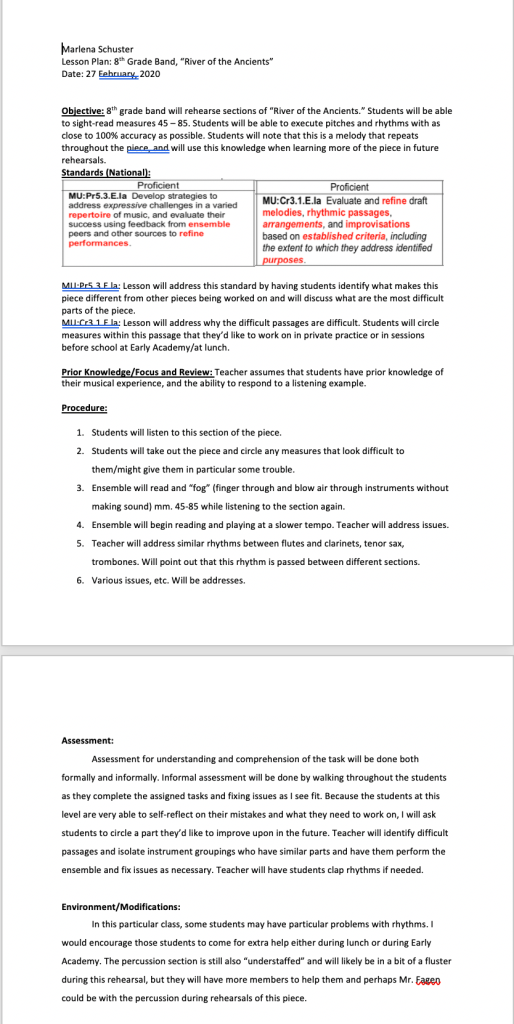
Weekly Reflection: This week was fantastic. I got to introduce the piece I’m going to conduct with the MS Band for NYSSMA/their concert, which I’ve played before and is my favorite piece for band. I have attached the lesson plan to this blog post. I had such a great time and a great experience working with them in this way, and I’m really excited about both how well it went and how excited the kids are about it!
Week 5
Without asking or looking at your cooperating teacher’s plan, observe one full class or rehearsal and list the musical objectives you think your cooperating teacher had in mind. State each as a full objective, using the language and/or wording you were taught in your methods courses.
MS: recall, musical literacy. HS: recall, musical literacy, expression
How can you tell from your observation that these were the objectives of the lesson or rehearsal?
In both cases, it was clear that these were the objectives because students were explicitly asked to do activities to strengthen their skills in notation and reading new music, but also recalling concepts from previous lessons.
How might these objectives represent a small portion of the larger music curriculum?
Music literacy and recall are both central concepts in music classrooms, and make up the foundation of being a musician, especially in an ensemble.
From this observation, how can you tell what the students already knew prior to this lesson?
It was clear to see where students in both schools were in their music literacy because they completed a written assignment and/or a handout. They were both also asked questions that would force them to think about previously-learned concepts.
How does your cooperating teacher assess student learning in this lesson?
Both teachers will grade the assignments but also circle the room and are able to provide real-time feedback and also make informal assessments.
Week 4
Worksheet 1.5
Observing Instructional Practices
| Name: | Marlena Schuster | Subject/Grade Level Observed: | MS/HS |
| Observation Date: | 02/3/20 and 2/4/20 |
Teachers must manage the learning environment to enable students to achieve the objectives established for the lesson. This observation form may help guide your observation and reflection on this instructional process in order to acquire a more comprehensive understanding of the teaching process.
Answer the following questions while observing your cooperating teacher. You are strongly encouraged to reflect back on your answers at the conclusion of the lesson to add in more detail and reflection.
1. How does the teacher focus the attention of students at the beginning of the class? If this is an elementary setting, howdo students enter and exit the room?
Both teachers and the middle and high school levels have routines for students such as where to put down their things and also a Do Now, usually related to the day’s lesson.
2. How does the teacher determine the students’ prior knowledge of a subject or concept?
In both cases, the teachers will ask the class about their prior knowledge by asking if anyone has heard of the concept and if they would like to try to explain it, or if anyone has heard the piece or song before, etc.
3. Does the teacher use a visual organizer or post an instructional outline to help direct student learning? When and how is it used?
Both teachers put powerpoint slides up outlining the lessons for the day.
4. If the students are assigned independent or small group work, what does the teacher do to ensure students understand the instructions? Is there more than one strategy for providing instruction?
This only happens in the high school, and he wanders the classroom and takes individual questions.
5. If students are assigned cooperative learning groups, when and how does the teacher give the instructions for the group work? How are the groups selected?
Students at the HS are able to select their own groups. Instructions are always outlined on the board.
6. How does the teacher assess student understanding?
Both teachers ask students questions in class and give take-home assignments.
7. What instructional strategies encourage participation of all students during large and small group work?
The teachers in both schools have such good rapports and relationships with the students that students are excited to participate in both settings simply because they enjoy the material and the teacher.
8. Does the teacher provide additional instruction while the students are working/playing? If so, how is this done?
Teachers will wander the classrooms and give feedback.
Week 3
WORKSHEET 1.7
1. How does the teacher establish behavior expectations at the beginning of the class period? MS: Dan has a routine which occurs every day, and the students have known it since they have worked with him. This has never seemed to be a problem. HS: It’s a bit different every day. Students have somewhat of an established routine, but it’s much more relaxed and he usually gets their attention by yelling over them.
2. How does the teacher establish a positive instructional learning environment? MS: Dan has a certain aura and rapport with the students that is inherently welcoming and positive. He gives feedback extremely well and is extremely approachable. HS: Craig is always there for the students and stays well after his required hours for students to come practice. He also has a fantastic rapport with the students.
3. What details does the teacher manage at the beginning of a class period or when implementing class transitions? Both teachers put up a powerpoint of what is going to happen during that class period and what is expected of students for the duration of the class.
4. What positive/negative reinforcements are used during class? Students at both schools are praised for answering and responding to questions, feedback, and information positively and calmly as well as for speaking one at a time.
5. Do students appear to understand the consequences for inappropriate behavior? More at the middle school than the high school. It sometimes seems as if the high schoolers might even understand but not really care.
6. What verbal classroom control techniques does the teacher use? Dan frequently reminds the class that only one person speaks at a time. Craig gets a bit more frustrated when students are not behaving properly so he may use a harsher tone with them.
7. What non-verbal classroom control techniques does the teacher use? Both teachers have the “teacher look” which is effective for both of them.
8. How are the classroom rules defined and adhered to during large and small group activities? All classroom expectations are outlined during the PowerPoints that each teacher uses.
9. How does the teacher bring closure to the class period? Usually the lesson just ends, in both cases. There isn’t much of a closing ritual rather than putting away instruments.
WORKSHEET 1.8
1. How do students enter the room? MS: Dan stands outside the door and greets students as they walk in. They put their bags down in the corner then begin to warm up as described in his powerpoint. HS: Students enter the room and put their things down, then go to get their instruments and warm up/talk as they please until Craig starts the class.
a. Are they energetic, enthusiastic, lethargic? MS: Students are always energetic and eager to be in Dan’s class. It’s truly inspiring. HS: It depends on the class; the jazz band is always enthusiastic and excited but most other classes seem distracted and/or not as interested as they could be.
b. How do you think they feel about coming to this class? All the students love Dan and thus love his class. It is clear that some students in Craig’s classes don’t want to be there and thus are constantly on their phones, not paying attention, etc.
2. Do they know the routine for entering the classroom, such as finding their seats, getting out instruments or music/texts? Students in both classes know the routines because they are described on the board daily.
3. What kinds of attitudes do you observe? Are they respectful of one another and the teacher? Students are generally respectful in both classes, with a few exceptions, mostly in Craig’s classes.
4. Do students appear to feel comfortable asking questions during class time? Explain your answer. Students in both cases feel comfortable as the teachers have great rapports with their students.
5. How do the answers to questions 1–4 influence the climate of the room? The climate of Dan’s classes is a lot more calm and relaxed to me, while sometimes in Craig’s classes, things feel a bit tense and stressful.
6. Are teacher expectations for student behavior, participation, and progress obvious to all? If so, how are they communicated? They seem much more obvious in Dan’s classes than Craig’s. However, Craig does much more formal assessment than Dan does.
7. Are students accountable for their own behavior and learning? If so, how is this demonstrated? Students in both classes are accountable through practice logs, video submissions, etc.
8. Is assessment teacher or student driven, or is it a combination of both? Assessment is primarily teacher-driven in both cases, but Dan gives students tools to assess their own progress by helping them analyze and identify what needs to be fixed and possible ways to fix it.
9. Does the teacher “praise” the students and their work? If so, how? Each teacher gives positive verbal feedback.
10. Describe the pace of the lesson. Fast, moderate, or slow? Lessons in both classrooms are well-paced.
11. How do the answers to questions 6–10 influence the climate of the room? In Dan’s classes, the climate is always positive. Sometimes in Craig’s classroom, the students seem to care about receiving good grades on their assessments more than anything else. This is likely because there are so many formal assessments.
Week 2
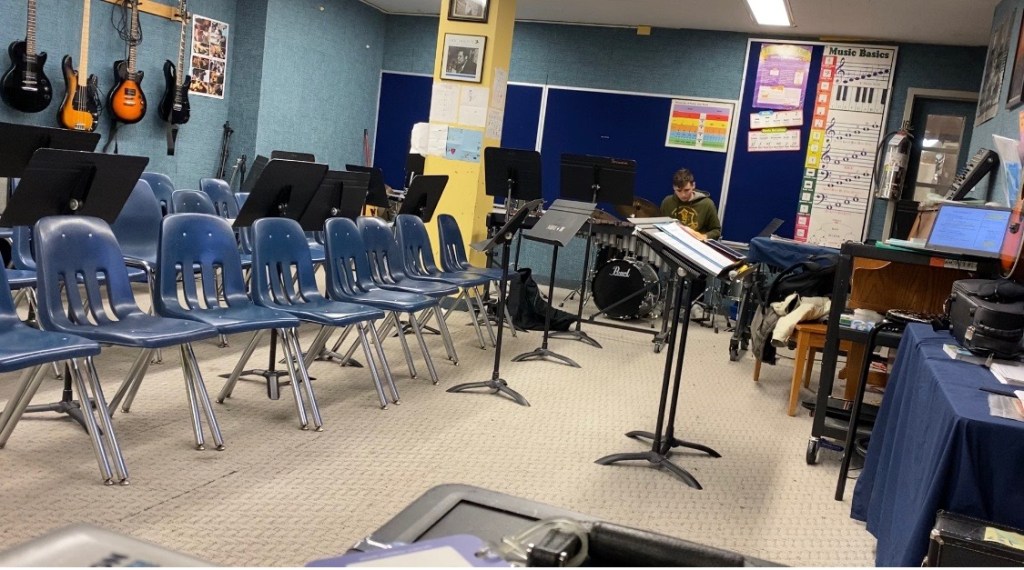
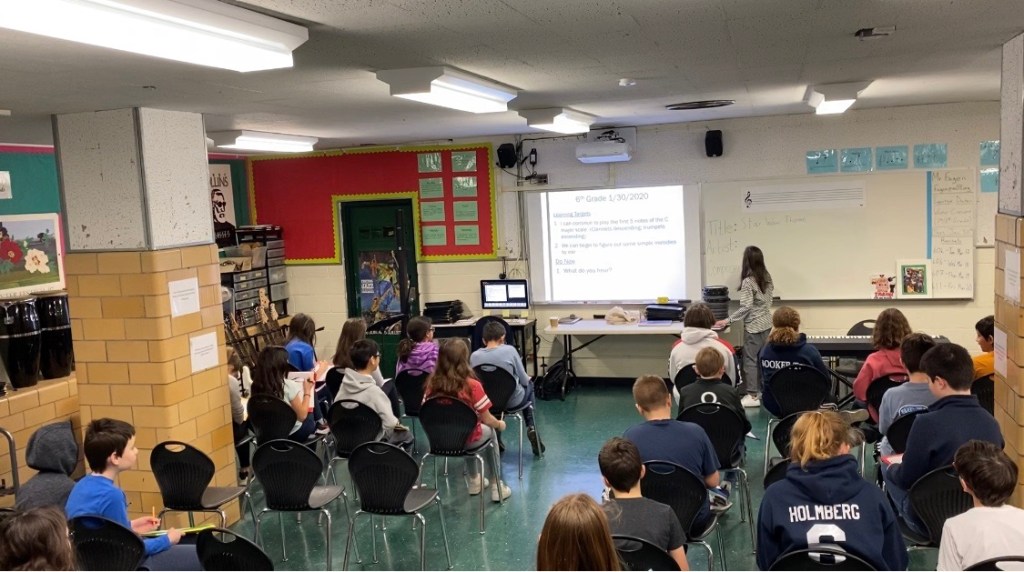
These classrooms are vastly different. At the high school, the music room is rather small (although there is an unseen space behind the camera that isn’t really utilized). Each classroom contributes to student learning in its own way. At the high school, the teacher is able to see everyone pretty much equally, and they are able to all feel engaged because of the proximity of their placement to the teacher. It feels, however, at the middle school, that sometimes the students in the back of the classroom are not engaged as much as at the high school, although that could be for a variety of reasons other than the proximity to the teacher. Each classroom is very able to be set up for other activities by stacking the chairs and moving the “center” of attention – i.e., the teacher’s “podium” or stand, both of which have been done in my presence. Each classroom has a water fountain either in it or very close to it. The bathrooms are quite far in both cases, as are the custodian and principal’s offices. The performances areas are, in both cases, directly above and to the left of the spaces, and both rooms are equipped with storage either in the room or next to it. I do have seating charts but have been asked not to attach them here. The classroom situations in both cases seem to be working quite well for both of my cooperating teachers, and they both have systems in place to address non-engagement that have been successful when I’ve observed them. I have felt able and comfortable teaching in both environments and addressing concerns and being off-task in both situations. I taught a lesson at the MS last week, and I was able to walk around the room and I felt that all the students were being engaged equally and well. I have attached the lesson plan here.
Week 1
First Impressions.
What am I expecting? As I have begun my student teaching, I’ve been pleasantly surprised with myself.
There are a few reasons for this. Firstly, the thing that I’ve struggled with the most as a music teacher is self-confidence. After just having completed my third week of teaching, I’ve noticed that I haven’t been nearly as scared or nervous as I’d expected, and I’ve been much more comfortable, especially at the beginning, than I thought I’d be. I am of course expecting and even embracing the inevitable time where I do feel overwhelmed and nervous, but I feel prepared for that moment and confident that I will be able to handle it.
What worries me? At the crux of my self-confidence issue is the fear of letting the students down. I want to be sure they’re given the best I can give and that they’re taking something valuable away from not only each lesson with me, but each interaction, each conversation. I’m learning through the process, though, that I have much more to offer than my anxiety wants me to believe.
What excites me? Everything. The kids that I’m working with are incredible, and I feel so blessed to have been placed in 2 schools in which I feel welcomed, comfortable, liked, respected, and am able to be myself and learn so much.
 Marlena's Student Teaching Journey
You must be logged in to post a comment.