
1. How does your cooperating teacher monitor student progress over time?
The cooperating teachers at each school monitor progress through both formal and informal assessment. At the HS, Craig has extremely frequent assessments that students turn in through online forums such as Seesaw and Google Classroom. At the MS, Dan has students complete low-pressure playing tests. He also has them do informal performances in class for their peers.
2. How does your cooperating teacher determine grades for music classes or ensembles?
In both schools, student participation and attendance make up a large chunk of the grade. At the HS, however, Craig uses grades from the frequent assessments. Dan uses practice logs and puts a big emphasis on participation as he will take points away for not behaving in class.
3. Collect documents pertaining to grading policies and procedures from your student teaching site. List the documents you have collected. Compare and discuss these policies and their relationships to implementation or practicality in music classes or ensembles.
From the MS: Practice log. Contains columns for date completed, time practiced, repertoire practiced, and parent and student signature.
From the HS: Everything is online, so there is not one written grading policy.
As compared with the sample grading policies I have collected, I think for my own classroom I’d like to hand out a “syllabus” of sorts at the beginning of the year and have kids sign and hand them back to certify that they understand my grading policy, which I’d love to have written out specifying exactly what I’d base grades on, including percentages.
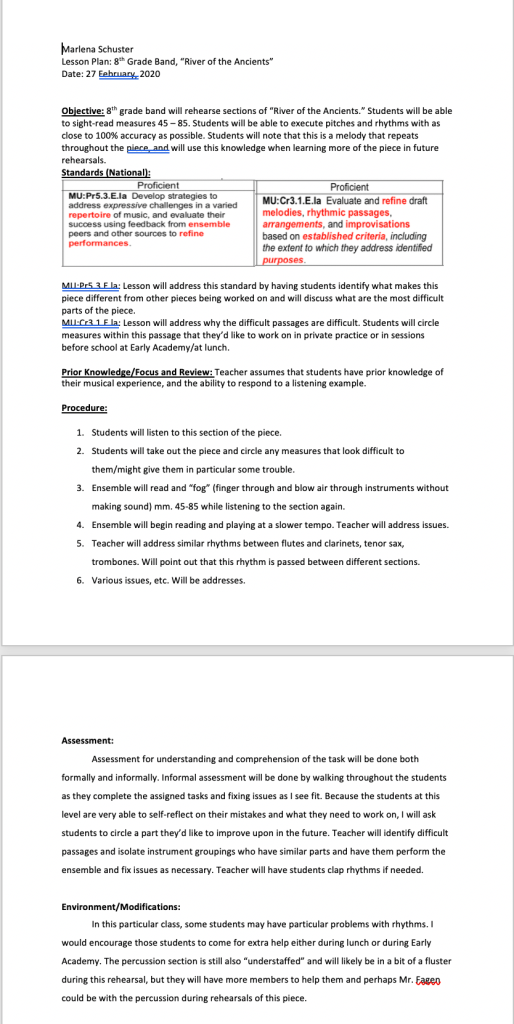
Weekly Reflection: This week was fantastic. I got to introduce the piece I’m going to conduct with the MS Band for NYSSMA/their concert, which I’ve played before and is my favorite piece for band. I have attached the lesson plan to this blog post. I had such a great time and a great experience working with them in this way, and I’m really excited about both how well it went and how excited the kids are about it!

 Marlena's Student Teaching Journey
Hello, Marlena!
I like the way Craig collects many forms of assessments many times each week. Something I’ve noticed: when a teacher collects fewer assessments, each becomes higher-stakes. This can be positive, but often, it can have detrimental outcomes for students. When a student misses or does poorly on an assessment, the outcome (when there are few opportunities for assessment) can end up assessing the timeliness of the student’s efforts or ability to negotiated stressful situations rather than measuring what the student knows. My advice is to structure many checks for student understanding including a variety of point values, weights, and modalities.
Class participation can be a tricky assessment, and usually each school will have a position on how to use these in the gradebook. Try to keep in mind what you are intending to measure, and then compare that with what class participation is measuring. Practice logs can also be tricky. Some teachers may count them for a majority of the student’s grade. Here’s the problem, some students may not be able to practice at home for any number of reasons. If you provide ample opportunity to practice at school, e.g. homework recovery days, you may be able to justify this assessment. Talk with your administrator and school counselors to see what they recommend. You’ll need your administrator’s support if there’s a conflict, so make sure you talk with them.
Your idea for a syllabus is very useful. Many schools will require teacher syllabi even at the secondary level. Student statements of understanding can be useful, but check with your administration on how to use them in your school context. Parents are often expecting these sorts of documents at the beginning of the year. You should also have a policy of how you will handle changes to the syllabi or student statements of understanding. My agreement with parents, especially regarding changing dates of performances, was that there would be no changes made to the calendar, and if a change was necessary, prior student and family scheduling commitments would be considered. Sometimes this meant excusing a student from a rescheduled performance assessment and allowing them to complete an alternative assessment. Note that I had the performance calendar set for the entire year on the first day of school. This includes making sure auditorium reservations and transportation contracts were solidified. We can talk more about this if you wish; I could write for quite a while on it as I came from a very “particular” school district experience.
I’m so excited that this week went well. And I’m so pleased that your CTs are allowing you to conduct at NYSSMA. That’s a wonderful and important experience for you! Have a great week!
–Robert
LikeLike
Marlena,
I am glad to hear that you had a great week with band. It is nice to see that you are beginning to step into more of a teacher role as apposed to observer or assistant. I like what are you are beginning to get to with this prompt. Like Robert said, class participation as a grade can be tricky. In my opinion, so can practice logs (but that is a longer conversation). I am getting a sense that there are things that you feel are missing or not as clear with your CT’s expectations of assessment. I would encourage you to continue talking with your CTs about their assessments of students. I would suspect that often, while it does not seem like a lot of assessment is going on, your CT knows exactly where each student is in their progress and what they expect from them.
Lauren
LikeLike